Understanding AI Implementation Costs
By Tracey Johnson (with the help of AI)

AI implementation can transform operations, but accurate cost assessment is essential for budgeting and ROI. This article outlines primary cost elements—licensing, hardware, implementation, and support—and gives a compact framework to help organizations plan and control expenses.
What Are the Key Cost Components of AI Solutions for Businesses?
Costs typically fall into clear categories. Identifying each one helps produce realistic budgets and reduce surprises during deployment.
Customization of AI Tools: Tailoring solutions to business needs can be costly depending on complexity.
Consulting Fees: External expertise speeds delivery but increases project spend.
Training for Employees: Staff training is required to realize the solution's value.
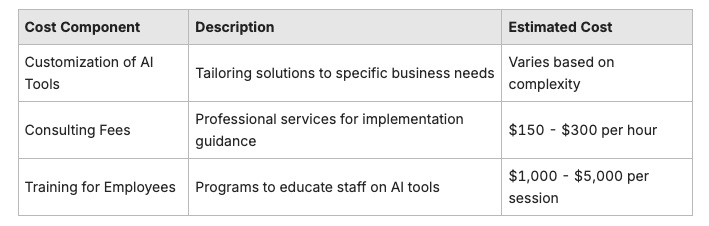
These items illustrate technical and human resource drivers that should be budgeted from design through monitoring.
AI Implementation Lifecycle: Design, Training & Deployment Costs
The paper examines strategic applications of AI within human capital management and provides a detailed review of the chatbot implementation lifecycle. It describes key phases such as use-case identification, architectural design and development, algorithm training and testing, deployment, and ongoing monitoring.
… Artificial Intelligence and Chatbots for Strategic Optimization in Human Capital Management: A Comprehensive Analysis of Implementation, Benefits, and Cost …, S Pandey, 2020
How Do Software Licensing and AI Tools Impact Implementation Costs?
Software licensing is often a major line item. Organizations should compare subscription versus perpetual models and factor in integration, configuration, and ongoing fees to estimate the total cost of ownership.
What Are the Hardware and Infrastructure Expenses in Internal AI Deployment?
Internal AI deployments commonly require significant hardware and infrastructure investment to meet processing, storage, and security needs. Plan for capacity, redundancy, and lifecycle upgrades. Small Businesses can often use cloud based hosting, which will reduce the cost significantly.
Server Costs: Compute for training and inference.
Network Infrastructure: Bandwidth and reliability to move data.
Maintenance Expenses: Updates, patches, and replacements.
How Can Businesses Effectively Budget for AI Integration Projects?
Start with a comprehensive estimate that includes software, hardware, implementation, and personnel. Use phased pilots (or testing) to validate assumptions, prioritize projects by expected ROI, and maintain contingency funds.
What Strategies Help Manage Hidden and Operational AI Costs?
Hidden costs arise from integration, data quality, change management, and maintenance. Improve visibility with tailored financial analyses and regular process reviews to reduce unexpected expenses.
Process Assessment: Identify inefficiencies and bottlenecks before automating.
Operational Efficiency: Target automations that deliver measurable savings.
Customized Financial Analysis: Reveal long-term operational costs and trade-offs.
How Does Financial Planning Influence AI Adoption Success?
Robust planning aligns resources with strategy and reduces implementation risk. Include initial investments, ongoing operational costs, and expected returns to make informed go/no-go decisions. Use reporting and KPI's to measure success or areas for improvement.
What Is the Financial Impact and ROI of AI Adoption in Business Operations?
AI can drive profitability, time savings, and cost reduction when applied to high-impact use cases. Focus on measurable outcomes and track baseline performance to validate benefits.
Increased Profitability
Time Savings
Cost Reduction
How Does AI Implementation Improve Profitability and Efficiency?
By automating routine work and optimizing workflows, AI frees staff for higher-value tasks and reduces friction across processes.
Streamlining Workflows
Automating Tasks
Improving Communication
Which Metrics Best Measure AI Project Returns?
Define metrics that map to business goals: ROI calculations, operational KPIs and cost-benefit comparisons. Extend measurement frameworks to include indirect productivity gains and qualitative outcomes.
Measuring AI ROI: Challenges & Economic Impact
The article addresses difficulties in quantifying AI's economic impact. It argues that traditional performance metrics underestimate productivity gains in cognitive work and outlines methodological and conceptual approaches to better measure AI-related returns.
Methodological Challenges AND Conceptual Approaches to Measuring the Impact OF Artificial Intelligence on Roi, L Moskalyk
How Do Coaching and Support Services Optimize AI Implementation Costs?
Coaching lowers friction, accelerates adoption, and prevents costly mistakes. Invest in change management and targeted training to protect project value. We provide:
Change Management Coaching
Employee Engagement
Reducing Turnover
What Role Does Business AI Coaching Play in Cost Management?
Coaching aligns technical deployment with operations, identifies improvement areas, and increases productivity by helping staff use tools effectively.
Streamlining Operations
Enhancing Productivity
Minimizing Disruptions
How Does Ongoing Support Enhance Operational Profitability with AI?
Continuous support preserves ROI by keeping systems aligned with changing needs and speeding onboarding and issue resolution.
Reclaiming Time
Improving Workflows and Reducing Bottlenecks
Enhancing Customer Communication
Frequently Asked Questions
What are the common challenges businesses face when estimating AI implementation costs?
Estimating costs is hard because scope, data readiness, and integration needs vary. Organizations often underestimate licensing, infrastructure, and training. Detailed scoping and contingency planning reduce surprises.
How can businesses assess the potential ROI of AI projects before implementation?
Run a cost-benefit analysis that includes direct savings and indirect value like time recovered and better decisions. Pilot comparable use cases and set clear baselines and targets.
What factors should be considered when selecting AI tools for implementation?
Choose tools that meet operational requirements, integrate with existing systems, and scale. Evaluate vendor support, total cost of ownership, and user experience to ensure adoption.
How can businesses mitigate risks associated with AI implementation costs?
Deploy in phases, run pilots to validate assumptions, keep a flexible budget with contingencies, and involve experienced consultants to spot hidden costs early.
What role does employee training play in the success of AI projects?
Training ensures effective use and adoption. Programs should cover technical skills and change management; ongoing training sustains utilization and productivity gains.
How can businesses track the effectiveness of their AI solutions post-implementation?
Use KPIs tied to strategic goals—productivity, cost, user, and customer satisfaction—compare against baselines, and review metrics regularly to guide optimization.
